C A R R Y
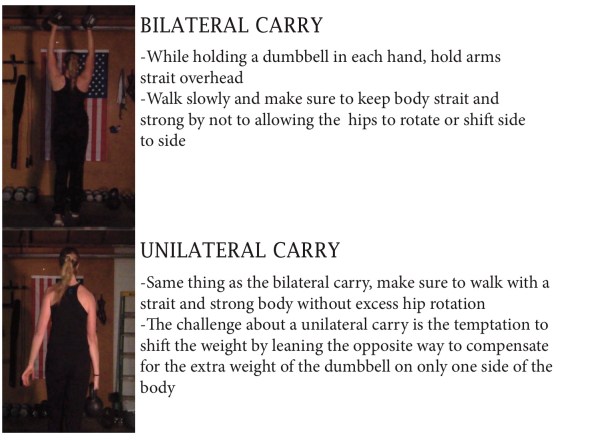
This movement is used anytime you walk while holding/carrying weight. It’s important for all people to practice this movement, as we are carrying things from one place to another all day long. Laundry, children, books, backpacks, groceries…you name it. There are two types of carries: unilateral and bilateral. A unilateral carry implies that a person is carrying a weight with equal distribution on both sides of the body. A bilateral carry movement implies that a person is carrying more weight on one side of the body than the other.
Primary muscles used: obliques, erector spinae, and abdominals. If the weight is carried overhead: Subscapularis, infraspinatus, teres minor, & supraspinatis.
Athletes who will benefit from practicing carry movements:
- Athletes who participate in races that involve obstacles (Spartan & Tough Mudder)
- Military personnel (special warfare, recon., combat, etc.)
- Rowers
- Skiiers
- Skaters
Benefits:
- Improved hip, knee, shoulder and back stability
- Increased strength in lumbar and thoracic spine
- Decreased chances of back injury
- Strength in transverse plane (obliques)
Assessment
Postural assessment
Common Faults
- Favoring/leaning to one side caused by muscle imbalances
- Outward rounding of upper back and shoulders: Kyphosis
- Walking with feet pointed outward or inward rather than strait
- Tilting head to one side as a means to stabilize spine
 Orenda