R O L L D O W N D E A D L I F T
The roll down deadlift is when a person will excessively arch their back when performing a deadlift instead of keeping back neutral and strong. While the muscles in the back and core are there as synergists to help support the action, the primary muscles that should be working in this lift are the glutes and hamstrings. Not only will that enable a person to lift more weight by using their legs, but it also reduces risks of back injury significantly.
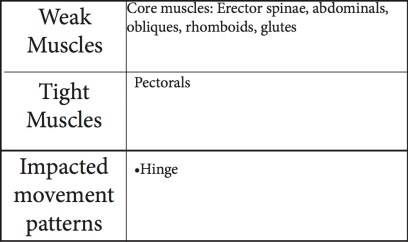
This deviation impacts the thoracic area of the kinetic chain and could be caused by a few different things:
- Since this is a kyphotic postural deviation, the pectoral muscles may be weak
- Core muscles may be weak
- Lack of understanding of how the movement should be performed
- Overall lack of proprioception (body awareness)
An important thing to keep in mind about deadlifts is that we use them all the time. Picking up heavy boxes, moving furniture, and picking up children are all examples where everyone can benefit from knowing the proper deadlift technique. Additionally, it’s important for athletes (particularly ones who perform olympic lifts) to master the deadlift because every single barbell lift starting from the ground begins with a deadlift.
Mobility Exercise: Door Stretch
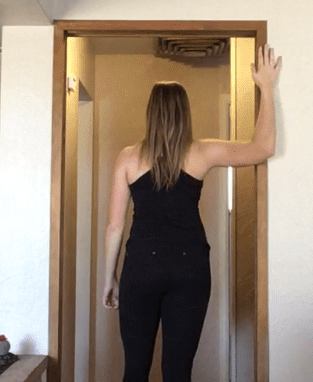
While standing in a doorway, press the hand and forearm flat against the surface (facing you) with the arm at a 90 degree angle. Stagger your stance and push your weight forward until you feel a stretch in the pectoral area.
TIPS:
- Depress and retract the scapula
- You may choose to stretch both sides at once if using a narrow doorway. This will help to deepen the stretch
- Turning your head the opposite direction will deepen the stretch
Stability Exercise: Plank

A proper plank will strengthen the core as well as engage all other muscle groups in the body. You can choose to do this in prone position, but side planks are also beneficial to the core particularly in the obliques.
T I P S:
- Elbows placed directly in line with shoulders
- Palms facing down and pointed strait ahead
- Feet placed in line with the hips
- Press weight backward with heels reaching for back of the room
- To avoid having a lordotic spine, actively flex the transverse abdominis and squeeze your glutes to come to a neutral spinal position
 Orenda